
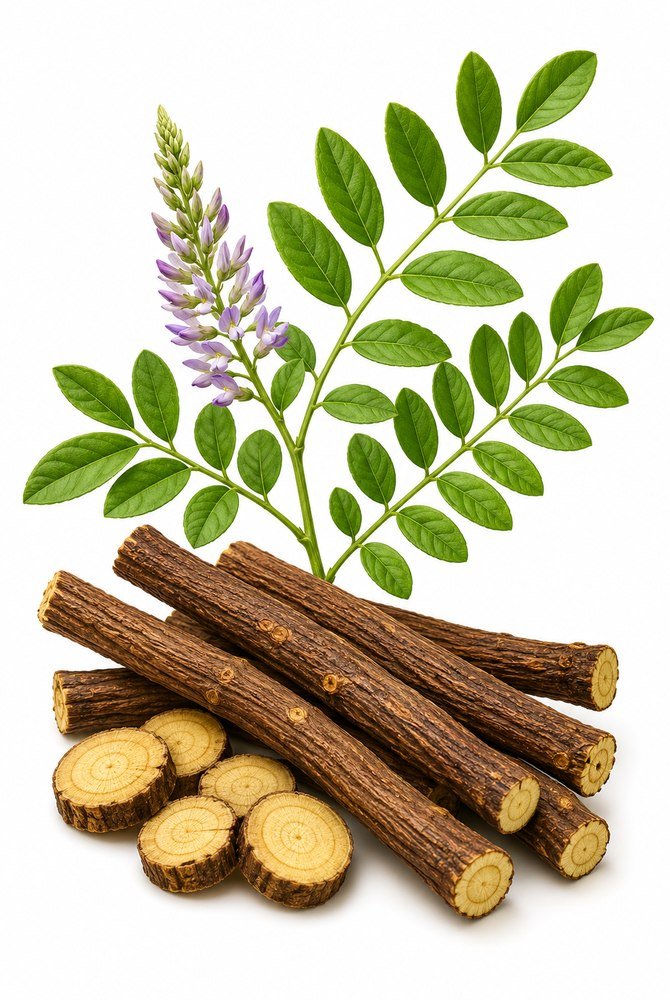
Licorice Root
Overview
Licorice root, the dried root and rhizome of a perennial legume, appears in more traditional Korean formulas than almost any other herb. Known as the harmonizer, it is used to moderate and unify the actions of other ingredients, ease the digestive system, and soothe coughs. The Donguibogam states this role in strikingly specific terms — that licorice alone can settle seventy-two kinds of mineral drugs and twelve hundred kinds of herbs into harmony, which is why the text honors it with the title 'elder statesman' (國老). The Korean saying 'like licorice in the medicine cabinet' describes something present everywhere. The text also records where the root's alternate name 'powder herb' (粉草) comes from — the root is judged good quality when it is firm and dense enough that snapping it releases a fine powder.
In the Donguibogam
寶鑑
Traditional uses recorded in the Donguibogam
- Harmonizes formulas
- Tonifies the spleen and qi
- Moistens the lung, relieves cough
- Relieves spasmodic pain
- Moderates herb toxicity
Traditional applications recorded in the classical text
- Digestive weakness
- Cough and sore throat
- Abdominal cramping
- Included in most classical formulas
Traditional preparation
Decoction 2–6g; roasted (honey-fried) licorice is used for tonifying purposes, since roasting is said to harmonize the middle while the raw root instead purges heat. The Donguibogam separately records two sub-parts: the thin root tip (梢), used for painful, difficult urination, and the root nodes (節), used raw to reduce swelling and clear toxicity.
Cautions
Frequently asked questions
Why is licorice in so many formulas?
Traditional sources describe licorice as harmonizing the hundred medicines: it moderates harsh ingredients, unifies a formula's action, and improves taste.
Is licorice root the same as licorice candy?
Not exactly. The herb is the dried root; much modern candy is flavored with anise instead of real licorice.
Does raw and roasted licorice work the same way?
No — the Donguibogam distinguishes them: roasted (honey-fried) licorice harmonizes and warms the middle, while the raw root instead purges heat, which is why prescriptions specify one or the other.
Sources
- 『동의보감』 탕액편, 허준, 1613 (원문) — 한문 원문
- 한의학고전DB (mediclassics.kr) — 원문 및 국역 자료 참조